
FIFA World Cup 2026 Prediction: The Recurring Pattern in World Cup Winners and Why the Netherlands Could Win
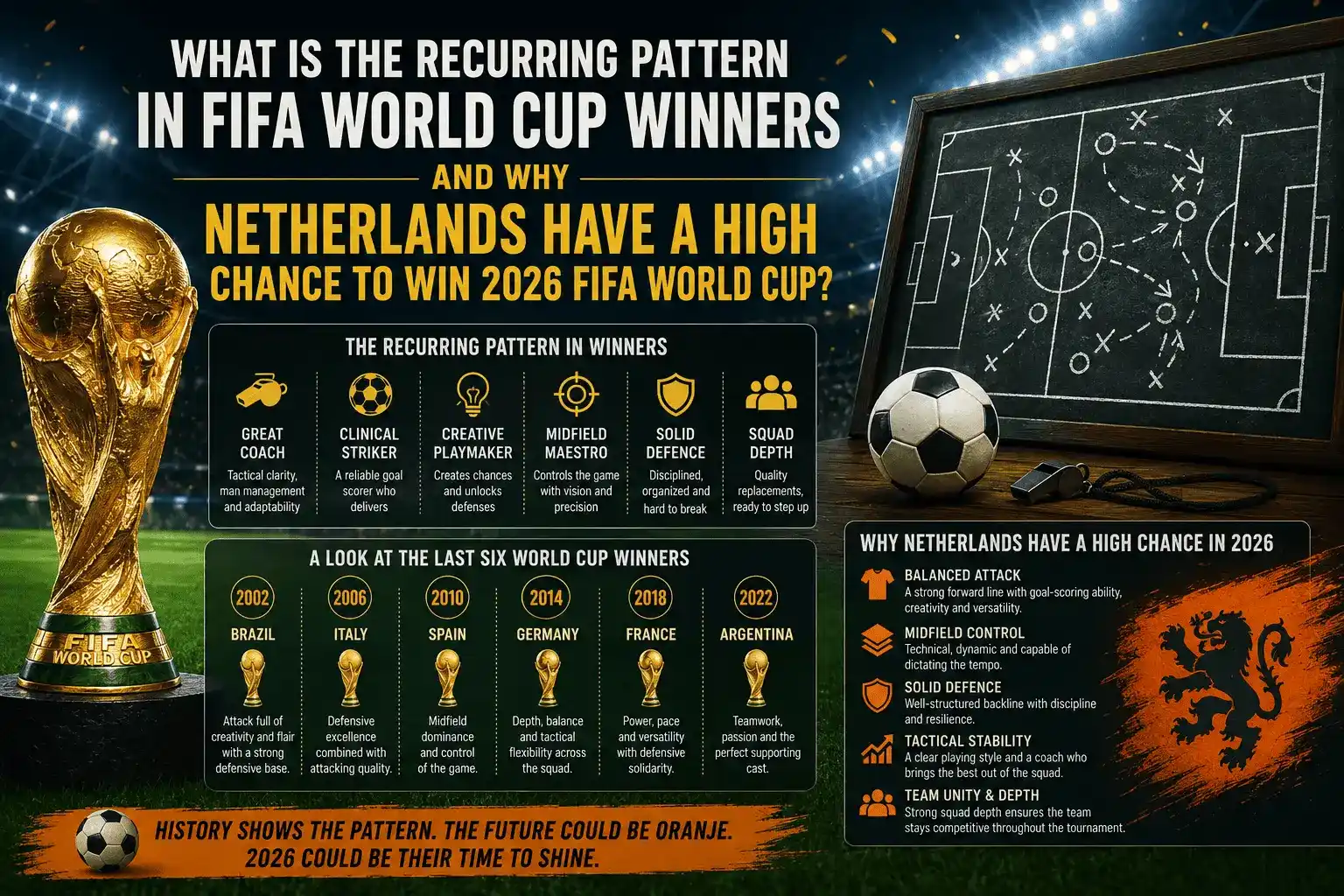
From 2002 to 2022 different teams have the won world cup, but there’s a reccuring pattern among the winners. While tactics and player styles change with every generation, World cup winning teams share some key characteristics:
- A world-class coach who can create a team spirit and implement tactical changes.
- A striker who has an eye for goal, a player who can disrupt the tactics of opponents, a space interpreter who can utilize the spaces created and a visionary orchestrator who can pass in to those spaces.
- A solid defense and squad depth with players to replace in key positions.
Looking at the world cup winners from 2002 to 2022 we can see this pattern consistently.
Brazil 2002: The Perfect Attacking Balance
Brazil’s 2002 World Cup star studded team is the perfect example of this:
- Ronaldo as the primary goal scorer and striker.
- Ronaldinho as the creator who could disrupt opponents.
- Rivaldo the intelligent attacker who could utilize spaces.
- Juninho and other midfielders who could make defense splitting passes.
Combined with a defense lead by Lúcio along with Cafu and Roberto Carlos.
Italy 2006: Creativity Built on Defensive Strength
Italy’s victory in 2006 world cup was the perfect example of defensive excellence along with attacking coexistence.
The squad featured:
- Filippo Inzaghi as a clinical finisher.
- Alessandro Del Piero as the creative attacking force.
- Francesco Totti as the player capable of interpreting space and linking attacks.
- Andrea Pirlo as the visionary orchestrator.
Behind them stood the rock solid defense lead by Cannavaro and Nesta.
Spain 2010: The Midfield Maestros
Spain dominated the 2010 world cup through keeping the ball and controlling the game.
Key players included:
- Fernando Torres as the clinical striker.
- David Villa as the player who could disrupt the opposition
- Andrés Iniesta who could exploit the spaces created.
- Xavi and Xabi both of them capable of exceptional passes.
- Puyol and Pique creating an indestructible defensive wall.
Germany 2014: Strength Through Depth
Germany’s triumph showcased perhaps the most complete squad of the modern era.
The team included:
- Miroslav Klose as the experienced striker.
- André Schürrle, Thomas Müller, and Mario Götze providing goals and movement.
- Toni Kroos and Mesut Özil controlling midfield and creating chances.
What made Germany special was their depth. Even when changes were required, the team’s quality barely dropped. Müller was arguably the most difficult player to replace due to his unique movement and productivity.
France 2018: Power, Pace, and Creativity
France combined youth and experience perfectly.
Their attacking framework consisted of:
- Olivier Giroud as the focal point.
- Kylian Mbappé providing pace and directness.
- Antoine Griezmann creating opportunities and linking play.
- Paul Pogba supplying vision and progression from midfield.
Defensively, France were compact, disciplined, and extremely difficult to counterattack.
Argentina 2022: The Complete Supporting Cast
Although Lionel Messi was the star, Argentina succeeded mainly because of the balance created by his teammates.
The squad featured:
- Julián Álvarez as the energetic strriker.
- Messi as the creator and match-winner.
- Ángel Di María as the space exploiter.
- Rodrigo De Paul and Enzo Fernandez as the midfield engines
Argentina’s defensive resilience and team spirit was also equally important to their success.
The Common Pattern
Across these six World Cup winners, we repeatedly see:
- An elite coach.
- A striker with goalscoring instinct.
- Creative play makers capable of generating chances.
- Midfielders with vision and passing quality.
- A strong defensive unit.
- Tactical balance between attack and defense.
The names change, but the formula remains remarkably similar.
Why the Netherlands Could Be Strong Contenders for the 2026 FIFA World Cup
If this pattern continues, the Netherlands appear to possess many of the qualities associated with previous champions.
A Balanced Attack
The Dutch squad features:
- Wout Weghorst who can score goals and create space for teammates with his physique.
- Cody Gakpo who can create space and also utilize space to score goals.
- Frenkie de Jong and Tijjani Reijinders capable of pulling out visionary passes and dictate the pace of the game.
Defense lead by experienced centre back Virgil Van dijk.
These players collectively provide a strong unit for Netherlands which make them a strong contender.
Tactical Stability
Under the coaching of Ronald Koeman, the Netherlands have developed a clear identity with a combination of technical and tactical ability. Also their experience in the tournament makes them a dangerous opponent for any nation.
Final Thoughts
Although we can find such patterns there is no guaranteed way for a team to win the world cup. Things like luck, injuries also play a pivotal role in the game.
However, history show that champions usually possess a combination of elite coaching, attacking quality, tactical ability, midfield creativity, and defensive solidity. Brazil in 2002, Italy in 2006, Spain in 2010, Germany in 2014, France in 2018, and Argentina in 2022 all displayed these characteristics in different ways.
Viewed through this lens, the Netherlands possess many of the same ingredients. If they maintain their balance, stay healthy, and peak at the right moment, they could emerge as one of the strongest contenders for the 2026 FIFA World Cup.